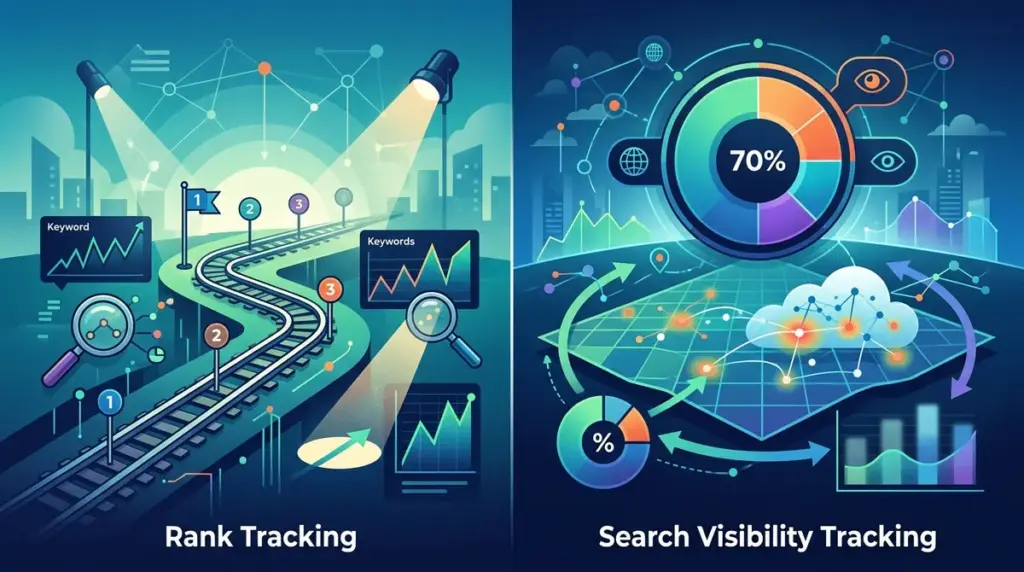
SEO reporting often collapses two distinct metrics into a single category, leading to strategic errors. Rank tracking and search visibility tracking serve different masters: one is a tactical diagnostic tool, while the other is a high-level performance indicator. Understanding the technical divide between a specific position on a SERP and your total share of voice determines whether you are optimizing for vanity or for revenue. Understanding the specific value proposition is key, so let's explore what a rank tracking tool is and why it matters for your SEO efforts.
Tactical Granularity of Individual Keyword Positions
Rank tracking is the process of monitoring the specific URL performance for a defined set of keywords. It is granular, providing a snapshot of exactly where a page sits in the search results at a given moment. This metric is essential for technical SEO audits and page-level optimizations. When a specific landing page drops from position three to position seven, rank tracking identifies the exact point of failure.
Best for: Identifying cannibalization issues, monitoring the impact of specific on-page updates, and tracking competitor movements on high-value "money" terms.
However, rank tracking in isolation is a narrow lens. A site can rank #1 for a thousand keywords, but if those keywords have a combined monthly search volume of 50, the traffic impact is near zero. Relying solely on rank tracking often leads to "keyword tunnel vision," where SEOs celebrate movements that have no measurable impact on the bottom line.
Market Share and the Search Visibility Index
Search visibility tracking is an aggregated metric that represents your brand's overall presence in a specific market or niche. Instead of looking at a single keyword, visibility calculations look at your entire keyword portfolio, weighting each rank by its search volume and estimated click-through rate (CTR).
Visibility is typically expressed as a percentage. A visibility score of 100% would mean you rank in the first position for every keyword in your tracking set. In reality, a score of 15% to 25% often indicates market leadership in competitive sectors. This metric allows stakeholders to see the "big picture" of brand health without getting bogged down in the volatility of individual keyword fluctuations.
- Aggregation: It smooths out the noise of daily rank changes across thousands of terms.
- Weighting: It prioritizes a drop in a high-volume head term over a gain in ten low-volume long-tail terms.
- Competitor Benchmarking: It provides a direct comparison of "Share of Voice" against industry rivals.
Why Search Volume Weighting Changes the Equation
The fundamental difference in visibility tracking is the inclusion of search volume. If you rank #2 for a keyword with 10,000 monthly searches, your visibility score will be significantly higher than if you rank #1 for a keyword with 100 searches. Rank tracking treats these as roughly equal successes; visibility tracking treats the former as a massive commercial win and the latter as a minor footnote.
Pro Tip: Never report visibility scores to clients without defining the keyword bucket. A visibility score is only as accurate as the keyword set it monitors. If you only track keywords you already rank for, your visibility will always look artificially high.
The Impact of SERP Real Estate on True Visibility
Modern search results are no longer a simple list of ten blue links. The rise of SERP features—Featured Snippets, People Also Ask blocks, Local Packs, and AI Overviews—has created a gap between "Rank" and "Visibility."
You may hold the #1 organic position, but if an AI Overview and a sponsored shopping carousel occupy the top 1,000 pixels of the screen, your "true" visibility is low. Sophisticated visibility tracking accounts for these features by adjusting the weight of the organic position based on its actual pixel depth on the page. Rank tracking might tell you that you are still #1, but visibility tracking will show a sharp decline in potential traffic because the organic result has been pushed below the fold.
Reporting Frameworks for Agencies and In-House Teams
Choosing which metric to emphasize depends on the audience of the report. SEO practitioners need rank tracking to do their jobs, while executives need visibility tracking to understand market position.
For Technical Teams: Use rank tracking to monitor "striking distance" keywords (positions 4-10) where a small optimization push could yield a significant CTR increase. Use it to spot-check how Google is rendering specific metadata or if a recent algorithm update targeted a specific content cluster.
For Marketing Directors and Stakeholders: Use search visibility to demonstrate ROI and market share. If the total visibility for the "Winter Footwear" category increased by 5% over a quarter, that is a clear indicator of successful content and link-building strategies, even if individual keywords moved up and down during that period.
The Danger of "Average Rank"
Many legacy tools provide an "Average Rank" metric. This is often a misleading middle ground between rank tracking and visibility. An average rank of 15 could mean you have five keywords at position 1 and five keywords at position 29. These two scenarios have vastly different commercial outcomes. Visibility tracking is a superior alternative to average rank because it applies the necessary mathematical weighting to reflect reality.
Aligning Metrics with Business Objectives
To move beyond basic reporting, integrate both metrics into a tiered analysis. Start with visibility to identify which categories or silos are underperforming relative to the market. Once a declining trend is spotted in the visibility index, dive into individual rank tracking to find the specific URLs and keywords causing the drag. This top-down approach ensures that your time is spent fixing problems that actually impact traffic volume rather than chasing minor fluctuations in low-value keywords.
Ultimately, rank tracking is about position, while search visibility is about reach. A successful SEO strategy requires the tactical precision of the former and the strategic oversight of the latter.
Frequently Asked Questions
Can my visibility go down if my ranks stay the same?
Yes. This happens if search volumes for your tracked keywords shift (e.g., seasonal trends) or if Google introduces new SERP features like ads or AI summaries that push organic results further down the page, reducing your share of voice.
Which metric is better for measuring competitor strength?
Search visibility is significantly better for competitor analysis. It allows you to compare the total "Share of Voice" between your domain and a competitor across a massive keyword set, providing a clearer picture of who dominates the niche.
How often should I check visibility vs. rank?
Rank tracking for high-priority keywords should be monitored daily to catch sudden drops or technical errors. Visibility is a macro-metric and is best analyzed on a weekly or monthly basis to identify long-term trends and the effectiveness of broad SEO campaigns.
Does search visibility include mobile and desktop data separately?
It should. Because SERP layouts and rankings often differ between devices, visibility must be calculated separately for mobile and desktop to accurately reflect how different segments of your audience see your brand.