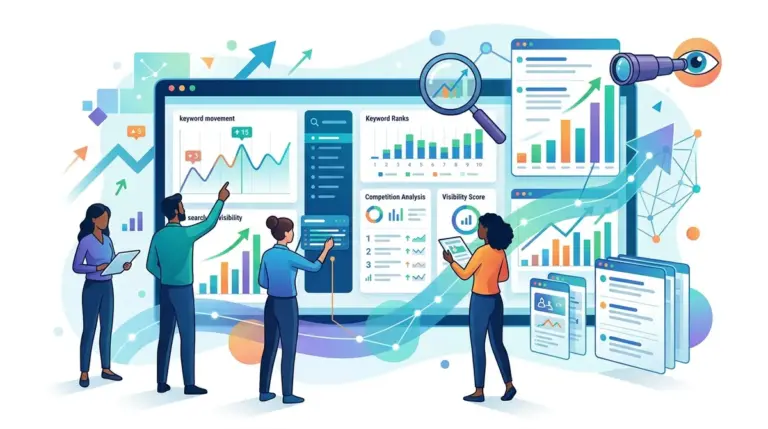
In organic search, visibility is a moving target. For a marketing manager or agency lead, knowing that a site ranks "on page one" is insufficient data for making high-stakes budget decisions. A rank tracking tool is the specialized software that automates the monitoring of keyword positions across search engine results pages (SERPs), providing the raw data necessary to calculate ROI, identify competitive threats, and pivot SEO strategies before traffic drops impact the bottom line. Understanding the core reasons why rank tracking still matters is key to making these strategic decisions.
Choosing to use a dedicated tracker over manual checks or the delayed data in Google Search Console is a transition from reactive guessing to proactive management. This guide breaks down the technical mechanics of these tools and why they are foundational to professional SEO operations.
The Mechanics of Automated Rank Monitoring
A rank tracking tool functions by simulating user searches across various locations, devices, and languages. Unlike a human searching from a single office desktop, these tools use distributed proxy networks to fetch unbiased results. This is critical because Google personalizes results based on search history, physical IP location, and device type. A rank tracker strips away this personalization to show where a site actually sits in the "clean" competitive landscape. This process highlights how rank tracking tools work to provide an objective view of search performance.
Data Freshness and Update Frequency
The value of a rank tracking tool is directly tied to its update frequency. In high-volatility sectors like e-commerce or finance, a weekly update is often too slow to catch the fallout of a core algorithm update. Professional-grade tools offer daily or even on-demand refreshes. This allows SEOs to correlate specific site changes—such as a new batch of backlinks or a technical site migration—directly with movement in the SERPs.
Granular Localization
For businesses with physical footprints, national-level tracking is misleading. A rank tracking tool allows for "hyper-local" monitoring, pinpointing positions down to the city, neighborhood, or even zip code level. This is essential for capturing data on the Local Pack (the map results), which often fluctuates independently of the standard organic blue links.
Why Position Data Drives Commercial Strategy
Rank tracking is not a vanity exercise; it is a diagnostic requirement. Without precise positioning data, it is impossible to perform a gap analysis or prioritize content updates. If a high-converting keyword drops from position 3 to position 7, the resulting click-through rate (CTR) decay can represent a 50% loss in potential leads. A tracker alerts you to this shift instantly.
Warning: Relying solely on "Average Position" metrics in Google Search Console can hide critical losses. Because GSC aggregates data over time, a sudden drop for a high-volume keyword can be masked by stable rankings for low-volume terms. Dedicated rank tracking tools isolate these high-value movements so you can act before the monthly reporting cycle ends.
Key Features That Differentiate Professional Tools
When evaluating a rank tracking tool, the utility lies in how the data is filtered and presented. Raw numbers are noise; actionable insights require specific features:
- Share of Voice (SoV): This metric calculates your brand's overall visibility across a set of keywords relative to your competitors. It weights rankings by search volume, providing a more accurate picture of market dominance than a simple count of top-10 rankings.
- SERP Feature Tracking: Modern search results are crowded with Featured Snippets, "People Also Ask" boxes, Image Packs, and Video Carousels. A professional tool tracks whether you own these features or if a competitor has leapfrogged you via a snippet.
- Competitor Benchmarking: You cannot evaluate your performance in a vacuum. Effective tools automatically track the top 10 or 20 competitors for your target keywords, showing you who is gaining ground and which content formats are currently favored by the algorithm.
- Tagging and Segmentation: Managing 5,000 keywords is impossible without organization. Tools that allow you to tag keywords by product category, intent (informational vs. transactional), or priority level allow for more nuanced reporting.
The Risks of Manual Rank Checking
Many site owners begin by manually typing keywords into Google. This is a flawed methodology for three primary reasons:
1. The Bubble Effect: Google knows who you are. If you frequently visit your own site, Google may artificially inflate your site's position in your personal search results. This creates a false sense of security while your actual market share may be declining.
2. Device Disparity: Mobile and desktop SERPs are no longer identical. Google’s mobile-first indexing means a site might rank #2 on a desktop but #8 on an iPhone due to page speed issues or layout shifts. Manual checking rarely accounts for these discrepancies across all device types.
3. Time Inefficiency: Checking 50 keywords across two devices and three locations takes hours of manual labor. A rank tracking tool completes this task in seconds, freeing up the SEO team to focus on the technical fixes and content creation that actually move the needle.
Integrating Rank Data into the Marketing Stack
For agencies and large enterprises, rank tracking data shouldn't live in a silo. The most effective use of these tools involves exporting data via API or direct integrations into visualization platforms like Looker Studio or Power BI. By overlaying ranking data with conversion data from Google Analytics, you can identify exactly which keyword movements result in the highest revenue growth. This allows for "ROI-based SEO," where resources are funneled into moving a keyword from position 4 to position 1 because the data proves that specific jump is worth $10,000 in monthly recurring revenue.
Establishing a Monitoring Workflow
To get the most out of a rank tracking tool, establish a consistent cadence for data review. Start by importing your primary "money keywords"—those with high intent and proven conversion rates. Once these are stable, expand into "top of funnel" informational terms to monitor your brand's reach. Set up automated alerts for significant drops (e.g., any keyword falling more than 5 positions) to ensure that technical errors or aggressive competitor moves are addressed within 24 hours.
Best for: Agencies managing multiple clients who need to prove value through transparent, third-party verified data, and in-house teams who need to justify SEO spend to C-suite executives.
Common Questions Regarding Rank Tracking
How often should I check my keyword rankings?
For most businesses, daily tracking is the standard. It provides enough data points to distinguish between "SERP dancing" (temporary volatility) and a sustained trend. Checking more than once a day is rarely necessary unless you are in a hyper-competitive news cycle or a major algorithm update is currently rolling out.
Why does my rank tracking tool show a different result than my browser?
This is usually due to localization and personalization. The tool uses a "clean" browser environment and a specific IP address (e.g., a Chicago-based server). Your personal browser uses your cookies, search history, and precise GPS location. The tool's data is more representative of what a new, objective user sees.
Can a rank tracking tool help with keyword research?
While their primary job is monitoring, many tools offer "keyword discovery" features. By analyzing which terms your competitors are ranking for that you are not, the tool identifies "content gaps." This allows you to build a roadmap based on proven competitor successes rather than starting from scratch.
Does rank tracking affect my site's performance?
No. Rank tracking tools do not interact with your website's server. They interact with the search engine's results pages. Using a tracker has zero impact on your site's load speed, security, or standing with Google.