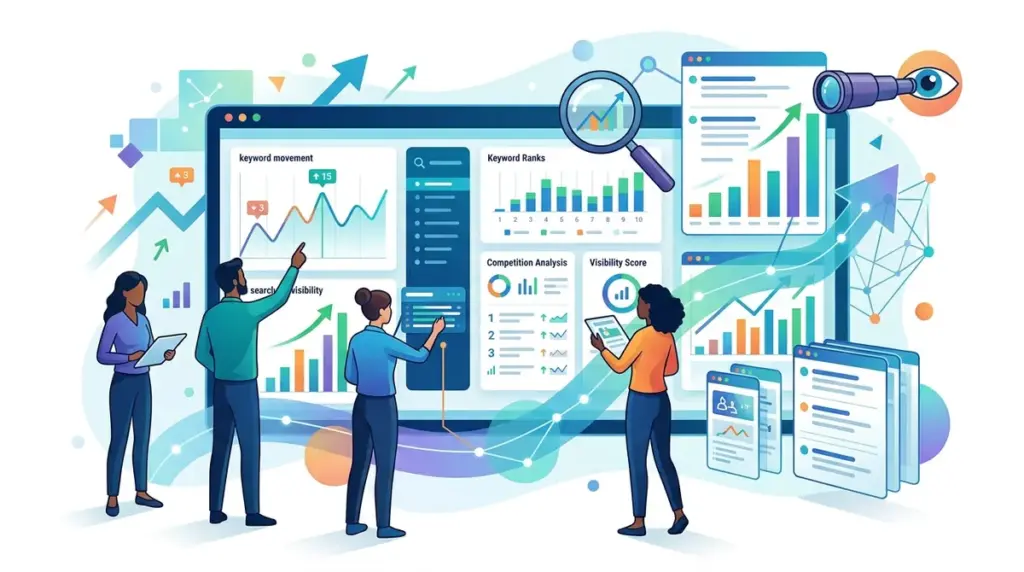
Most SEO professionals treat rank tracking as a vanity exercise—a way to show a client a line moving up and to the right. But in a landscape where Google’s Search Engine Results Pages (SERPs) change hourly and vary by street corner, a basic list of positions is no longer a viable business asset. A professional-grade rank tracking tool must do more than scrape data; it must provide a definitive map of a brand’s digital real estate and the commercial value attached to it. Understanding exactly what a rank tracking tool should do is the first step to leveraging it effectively for business growth.
The gap between a "good enough" tracker and a high-performance tool lies in the granularity of the data and the speed at which it is delivered. If your tool updates once every three days, you are essentially making decisions based on yesterday’s news. To compete in high-volatility niches like e-commerce or SaaS, you need a platform that treats rank tracking as a live diagnostic tool rather than a monthly archive. In volatile markets, grasping why rank tracking still matters today means treating it as a live diagnostic, not a historical record.
Precision Beyond the Standard Blue Link
Modern search results are a fragmented collection of "position zero" snippets, local packs, video carousels, and "People Also Ask" boxes. A tool that only reports a numerical rank for organic blue links is ignoring roughly 40% of the visible SERP. A high-utility tracker must distinguish between a traditional organic result and a SERP feature. If you rank #1 but a massive AI Overviews block and a four-pack of ads push you below the fold, your "top rank" is functionally invisible.
Best for: Identifying "hidden" traffic drops where rankings remain stable but click-through rates (CTR) plummet due to new SERP features.
Look for tools that provide "pixel depth" or "above the fold" metrics. This data tells you exactly how many pixels down the page your result sits. If a competitor wins a Featured Snippet for your primary keyword, a good tool should alert you immediately, as that shift represents a direct threat to your organic traffic share, regardless of whether your numerical rank stayed the same.
Granular Local Tracking and Geo-Specific Data
For businesses with physical footprints or regional service areas, national-level tracking is useless. Search results in New York are not the search results in Chicago. A professional rank tracking tool must allow for zip-code level or even coordinate-level tracking. This is particularly critical for the "Map Pack" or "Local Pack."
The Mobile-First Reality
Google’s move to mobile-first indexing means your desktop rankings are often a secondary concern. A good tracker must allow you to split your views between mobile and desktop effortlessly. You will frequently find that a site ranking #2 on desktop might be #5 on mobile due to different ad layouts or the presence of mobile-only features like "Short Videos." If your tool doesn't let you toggle these views, you are seeing only half the story.
Warning: Beware of tools that report "Average Position" as their primary KPI. Average position is a mathematical abstraction that hides volatility. A site can have an average position of 10 by having one keyword at #1 and another at #19, or two keywords at #10. These two scenarios require completely different strategic responses.
Share of Voice and Competitive Intelligence
Rankings are relative. If your position improves but your competitors improve faster, you are losing market share. A sophisticated tool should calculate "Share of Voice" (SoV)—a metric that weights your rankings by the search volume of each keyword. This provides a macro view of your brand’s authority within a specific niche.
Actionable Metric: Use SoV to identify which competitors are gaining ground during core algorithm updates. If your rankings are stable but your SoV drops, it means competitors are capturing new, high-volume keywords that you haven't yet targeted.
Furthermore, the tool should automatically track "discovered" competitors. Often, your biggest search competitors aren't your direct business rivals; they are informational sites, publishers, or aggregators that hog the top spots for your "how-to" and "best-of" queries. A good tracker identifies these players before they become a permanent fixture at the top of the SERP.
Infrastructure and Data Accessibility
For agencies and enterprise teams, the user interface is often less important than the API. Data needs to be portable. A tool that locks your data inside a proprietary dashboard is a bottleneck. High-tier tools offer robust API access and native connectors for Looker Studio, Power BI, or Google Sheets. This allows you to blend ranking data with conversion data from Google Analytics 4 (GA4) or CRM data from Salesforce.
- On-Demand Updates: The ability to manually refresh a keyword set after a major site migration or a content refresh.
- Historical Data Retention: Access to at least 24 months of data to identify seasonal trends and long-term recovery patterns.
- Tagging and Segmentation: The ability to group keywords by product category, intent (informational vs. transactional), or funnel stage.
- Multi-User Permissions: Granular control over who can edit keyword lists versus who can only view reports.
Establishing a High-Performance Tracking Workflow
To get the most out of a rank tracking tool, stop tracking every keyword you’ve ever thought of. Focus your tracking on three specific buckets: High-Value Conversions (the keywords that pay the bills), Striking Distance Keywords (those ranked #4 through #12 that need a push), and Defensive Keywords (your brand terms).
A good tool facilitates this by allowing you to set custom alerts. Instead of checking a dashboard every morning, you should receive a notification only when a "High-Value" keyword drops out of the top three or when a new competitor enters the top ten for your "Striking Distance" set. This shifts your workflow from passive monitoring to active intervention.
Finally, consider the cost-per-keyword. Many tools use a credit-based system that can become prohibitively expensive as your portfolio grows. Ensure the pricing model scales with your business without penalizing you for the granular tracking (daily updates, mobile vs. desktop) that is necessary for modern SEO.
Frequently Asked Questions
How often should a rank tracker update?
For most businesses, daily updates are the standard. However, during a site migration or a major Google algorithm update, on-demand refreshing is necessary to make real-time technical adjustments. Weekly updates are generally insufficient for active SEO management.
Is "Position 1" always the top result?
No. With the rise of Featured Snippets, Sponsored Ads, and AI Overviews, the first organic result can often appear several hundred pixels down the page. A good tool will show you the "Visual Rank" or indicate which SERP features are appearing above your link.
Why do my tool's rankings differ from what I see on Google?
Google personalizes results based on your browsing history, IP address, and device. Rank tracking tools use "clean" browsers and specific data centers to provide an unbiased, localized view. The tool’s data is typically more representative of what a new, neutral user would see.
Should I track thousands of keywords?
Quality beats quantity. It is better to track 500 keywords with high granularity (daily updates, local tracking, mobile vs. desktop) than 5,000 keywords with weekly, national-only data. Focus on the terms that actually drive revenue.