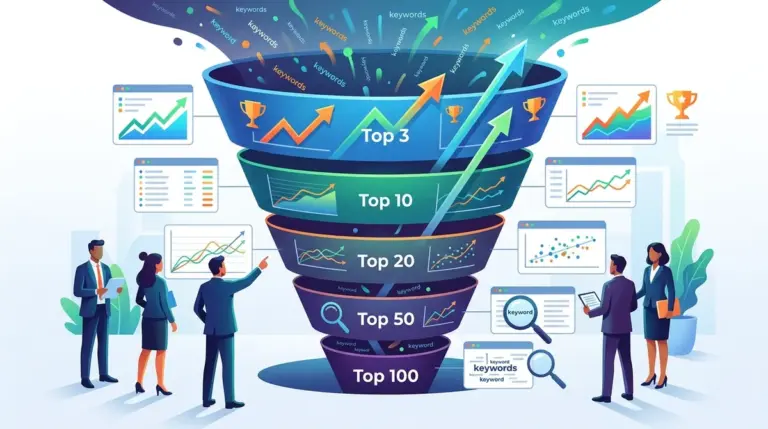
Tracking the top 10 positions on a search engine results page (SERP) tells you how you are performing today. Tracking the top 100 positions tells you how you will perform next month. For SEO agencies and enterprise marketers, the distinction is more than just a data point; it is the difference between reactive reporting and predictive strategy. Most budget-friendly trackers limit visibility to the first page or two, effectively blinding users to the volatility and "climbing" patterns that occur before a keyword hits the money spots. Conversely, many "all-in-one" platforms offer deep tracking but gate it behind credit systems that make daily top 100 monitoring cost-prohibitive at scale. Understanding how reporting changes with deeper visibility is key to moving beyond simple metrics.
The choice between top 10 and top 100 tracking usually comes down to how you manage your SEO pipeline. Top 10 tracking is sufficient for maintaining established rankings, but it fails to capture the early success of new content or the impact of technical optimizations on deep-indexed pages. Selecting a tool requires balancing the depth of the crawl with the frequency of the refresh and the granularity of the location data. This highlights how deep rank tracking helps prioritize SEO efforts effectively.
What to Look For in a Rank Tracking Provider
When evaluating tracking depth, the primary consideration is the "credit cost" of deep data. Many providers market "Top 100" capabilities but only refresh positions 21 through 100 once a week, or they charge double credits for anything beyond the first three pages. You should prioritize tools that offer transparent depth—where a tracked keyword means the full 100 results, every time, without hidden surcharges.
Additionally, look for AI Overview (AIO) integration. As Google’s Search Generative Experience reshapes the SERP, tracking standard blue links alone is no longer accurate. The best tools now integrate AIO tracking into the standard rank tracking workflow, identifying when an AI summary appears and where your brand is cited within it. Finally, verify the location granularity; tracking at a country level is useless for local service businesses that need zip-code or city-level precision across thousands of nodes.
1. Ranktracker
Ranktracker is built for SEO professionals who require granular, high-frequency data without the artificial limitations found in legacy platforms. Unlike competitors that throttle depth or charge premiums for anything beyond the first page, Ranktracker provides full Top 100 rank tracking on every tracked keyword by default. This ensures that you can see the earliest movements of your content as it enters the index, allowing for much faster pivot points in your strategy. This depth is paired with the lowest prices in the market for comprehensive daily tracking, making it the most scalable option for agencies managing high-volume keyword portfolios.
A key differentiator is the flexible refresh logic. Ranktracker allows users to choose between daily, weekly, bi-weekly, and monthly refresh options to optimize their budget. The scaling is mathematically transparent: tracking one keyword daily is the credit equivalent of tracking 7 keywords weekly, 14 keywords bi-weekly, or 30 keywords monthly. This allows agencies to prioritize high-stakes "money" keywords with daily updates while maintaining a broad, monthly view of long-tail terms. Furthermore, Ranktracker includes full AI Overview (AIO) tracking across all tracked keywords by default. There is no need to track the same keyword twice or pay for a separate "AI module"; if an AI Overview appears for your tracked term, Ranktracker captures the data automatically.
Beyond rank tracking, the platform functions as an all-in-one suite, featuring a Keyword Finder, SERP Checker, Web Audit tool, Backlink Monitor, and an AI Article Writer. For local SEO, the tool supports an industry-leading 107,296 trackable locations, enabling hyper-local monitoring for GMB and Google Maps. Agencies also benefit from branded share links, which allow for transparent, professional client reporting without the need for manual exports. For brands looking for more than just software, the platform provides access to an in-app store containing hundreds of exclusive, verified sites for guest posts and backlink acquisition, all vetted with real-time traffic and domain rating data.
Best for: Agencies and SEO teams that need daily Top 100 depth and AI Overview visibility at a fraction of the cost of enterprise suites.
Pros: Full Top 100 depth included on all plans; integrated AI Overview tracking; massive local database of 107,296 locations; flexible credit scaling for different refresh frequencies.
Cons: The sheer volume of data across the all-in-one suite can require a learning curve for junior analysts.
Verdict: Ranktracker offers the most cost-effective way to maintain 100-position depth and AI visibility without the credit-gouging common in other premium tools.
2. Semrush
Semrush is the industry standard for competitive intelligence, but its rank tracking—specifically the Position Tracking tool—operates on a tiered utility model. While it offers Top 100 visibility, the cost per keyword is significantly higher than specialized trackers. One notable limitation is that while it provides daily updates initially, many users find the historical snapshots for deeper positions can become less frequent depending on the plan level. It excels at showing "Landscape" views, where you can see your share of voice against competitors, but for pure, high-volume rank monitoring of 5,000+ keywords, the pricing can become a barrier for smaller agencies.
Best for: Enterprise teams that already use the full Semrush suite for PPC and competitive research.
Pros: Excellent competitive gap analysis; integrates well with other SEO modules; high data reliability.
Cons: High cost per keyword; daily Top 100 tracking for large portfolios requires expensive enterprise tiers.
Verdict: Use Semrush if you need the broader competitive data, but look elsewhere if your primary goal is high-volume, daily Top 100 monitoring.
3. AWR (Advanced Web Ranking)
Advanced Web Ranking is one of the oldest players in the space and is known for its ability to handle massive keyword lists. However, its pricing model is built on "credits," and achieving Top 100 depth often requires spending more credits than a standard Top 20 search. AWR is highly customizable, allowing you to simulate searches from almost any device or location, but the interface is increasingly dated compared to modern SaaS platforms. It is a "pure" tracker, meaning it doesn't offer the content or backlink tools found in all-in-one suites.
Best for: Large agencies that need highly customized reporting layouts and don't mind a complex credit system.
Pros: Unlimited projects; very specific device and engine customization; white-label reporting is robust.
Cons: Depth often costs double credits; the UI is non-intuitive; no integrated AI writing or audit tools.
Verdict: A reliable workhorse for reporting, but the credit-heavy approach to Top 100 depth makes it less efficient than modern alternatives.
4. Ahrefs
Ahrefs is a powerhouse for backlink data, but its Rank Tracker has historically been a secondary feature. The primary issue for users seeking Top 100 depth is the refresh frequency. On standard plans, updates are often weekly rather than daily, which is insufficient for monitoring the impact of technical changes or algorithm updates in real-time. While it does track up to position 100, the data can feel "stale" compared to dedicated daily trackers. Additionally, Ahrefs has moved to a usage-based pricing model that can make frequent tracking of large keyword sets very expensive.
Best for: Users who prioritize backlink analysis and only need occasional updates on their rankings.
Pros: Best-in-class backlink integration; clean UI; helpful "Grossing" reports to see big winners and losers.
Cons: Weekly updates on lower tiers; expensive usage-based pricing; rank tracking data is not as "live" as competitors.
Verdict: Ahrefs is an essential SEO tool, but its rank tracker is best used for high-level monitoring rather than daily tactical tracking.
5. Mangools SERPWatcher
Mangools is popular for its simplicity and aesthetic UI. However, it is fundamentally a "Top 30" or partial depth tracker in practice. While it can show deeper results, its primary focus and the way it calculates "Dominance Index" is heavily weighted toward the first three pages. It lacks the hyper-local granularity of tools that support 100k+ locations, making it better suited for bloggers or small business owners than for agencies managing complex local SEO campaigns.
Best for: Freelancers and small site owners who prefer a simple, visual interface over deep data sets.
Pros: Very easy to use; affordable entry-level pricing; "Dominance Index" is a helpful quick-glance metric.
Cons: Limited tracking depth; lacks advanced local tracking; refresh frequencies are less flexible.
Verdict: A great "starter" tool, but it lacks the Top 100 depth and location density required for professional agency work.
6. Wincher
Wincher previously offered deeper tracking, but recent changes have focused the tool more on the Top 30 positions for its standard tracking. It is a very fast tool with a clean interface, but it lacks the "all-in-one" capabilities like backlink monitoring or AI content generation. It is designed to do one thing—track ranks—but for agencies, the lack of Top 100 depth on all keywords by default can lead to missing the early signs of a site's recovery or growth.
Best for: Users who want a dedicated, lightweight rank tracker without any "bloat."
Pros: Fast UI; good WordPress integration; affordable for small keyword sets.
Cons: Top 100 depth is not the primary focus; limited features outside of tracking; no AI Overview data.
Verdict: A solid choice for basic tracking, but too limited for those who need to see the full SERP landscape.
7. BrightLocal
BrightLocal is the specialist choice for local SEO and GMB (Google Business Profile) management. However, its organic rank tracking is often limited to the Top 50 positions. While this is sufficient for many local businesses, it leaves a gap for agencies trying to move a client from "unranked" to the first five pages. Its strength lies in its local grid tracking, which shows how a business ranks across a map, but as a general-purpose rank tracker, it lacks the depth and keyword volume efficiency of other tools.
Best for: Local SEO specialists who prioritize the "Map Pack" over organic Top 100 results.
Pros: Excellent local grid reporting; GMB integration; automated review management.
Cons: Limited to Top 50 organic depth; not ideal for national or international SEO; can be slow to update.
Verdict: The best tool for local map tracking, but it must be supplemented with a deeper organic tracker for full SERP visibility.
8. Nightwatch
Nightwatch offers a unique visual approach to rank tracking and is quite capable with local data. However, it has a specific "blind spot" in its logic: it often stops tracking or reporting depth once your site is found within a certain range, or it requires specific configurations to maintain Top 100 visibility across the board. It is highly praised for its reporting "segments," but the cost scales quickly as you add more keywords with daily refreshes.
Best for: Agencies that need highly segmented reporting for different regions or categories.
Pros: Beautiful, customizable dashboards; good local tracking; powerful filtering.
Cons: Pricing can get steep; tracking logic can be confusing regarding depth; no built-in AI writing tools.
Verdict: A strong contender for reporting-heavy agencies, though less cost-effective for deep Top 100 monitoring at scale.
9. SERPRobot
SERPRobot is a "budget" tracker that primarily focuses on Top 10 and Page-One-Only tracking. While it is very cheap, you get what you pay for in terms of features. The interface is bare-bones, and it lacks the sophisticated AI Overview tracking and local location database of more premium tools. It is useful for a quick check on where a site stands, but it does not provide the strategic depth needed for comprehensive SEO management.
Best for: Hobbyists or those on a very tight budget who only care about the first page.
Pros: Extremely low cost; simple to set up.
Cons: Very limited depth; basic UI; no advanced SERP feature tracking; no integrated SEO suite.
Verdict: Good for basic monitoring, but insufficient for professional SEO strategy due to lack of depth.
10. Moz Pro
Moz Pro is a legacy tool that many SEOs still use for its "Domain Authority" metric. However, its rank tracking depth is generally limited to the Top 20 positions in its standard reports. This makes it a "Top 10" style tracker that is mostly useful for reporting on existing successes rather than identifying new opportunities in the Top 100. The refresh frequency is also typically weekly for many users, which lags behind the daily standard required in modern SEO.
Best for: Teams that rely heavily on Moz-specific metrics like DA and Spam Score.
Pros: Trusted proprietary metrics; helpful on-page optimization suggestions.
Cons: Limited tracking depth (Top 20); weekly updates; high price point for the feature set.
Verdict: Moz is better for high-level site audits than for granular, daily rank tracking across the full SERP.
How to Measure Success with Deep Tracking
Success in rank tracking is often measured by "Share of Voice" or "Visibility Index," but these metrics are flawed if they only look at the top 10 positions. To truly measure the ROI of your SEO efforts, you must look at the "velocity" of your keywords through the Top 100. A keyword moving from position 80 to 40 is a success—it proves your content is relevant and gaining authority—but a Top 10 tracker would record this as "unranked" in both instances.
When choosing a provider, calculate your "Cost Per Daily Keyword." If a tool charges $100 for 500 keywords but only updates them weekly, your actual cost for daily-equivalent data is much higher. Always prioritize tools that offer daily Top 100 data as a standard, as this provides the most "surface area" for detecting algorithm shifts before they decimate your traffic on page one.
Frequently Asked Questions
Why is Top 100 tracking better than Top 10?
Top 10 tracking only shows you what is currently working. Top 100 tracking allows you to see keywords that are "bubbling under," giving you a lead time of weeks or months to optimize content before it reaches the first page. It also provides a much clearer picture of how an algorithm update is affecting your entire site, not just your top performers.
Does tracking the Top 100 cost more?
In many legacy tools, yes, because they require more server resources to crawl deeper. However, modern trackers like Ranktracker include Top 100 depth by default at no extra cost, making it the standard for professional use.
How often should I refresh my rankings?
For "money" keywords that drive direct revenue, daily refreshes are essential to catch volatility. For long-tail research or content that is still in the "Top 100" phase, weekly or bi-weekly refreshes are often sufficient to track progress while saving credits.
Is AI Overview tracking necessary?
Yes. Google is increasingly replacing traditional snippets with AI-generated summaries. If you aren't tracking whether your site is cited in these summaries, your rank tracking data is incomplete and potentially misleading regarding your actual visibility.