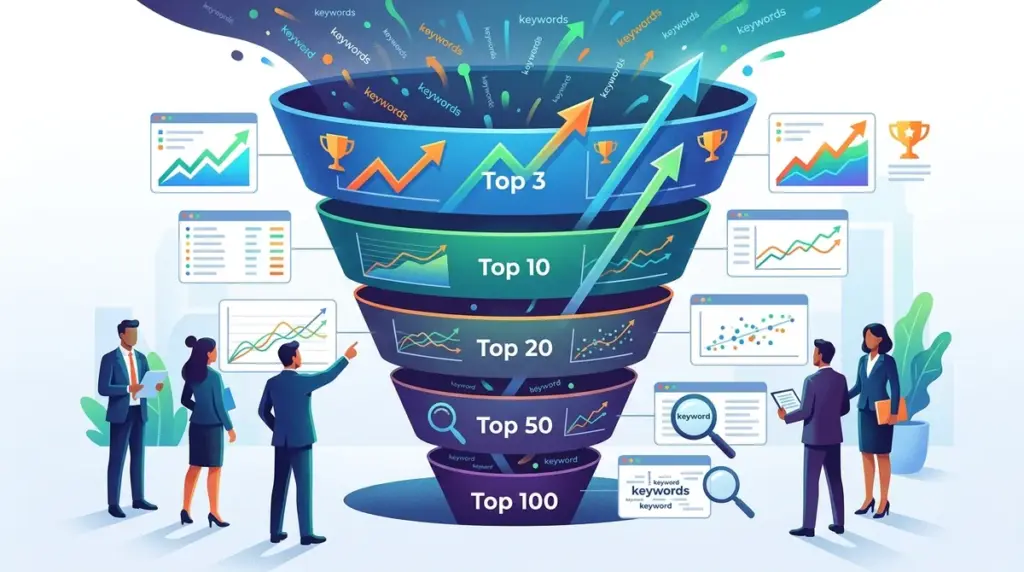
Most SEO reports focus exclusively on the "money" positions—ranks 1 through 3. While these drive immediate revenue, they are a lagging indicator of SEO performance. If you only report on the top 10, you are effectively ignoring 90% of the movement generated by content updates and technical fixes. Standardizing your reporting around ranking depth—tracking how many keywords sit in the top 20, 50, or 100—shifts the conversation from "why isn't traffic up yet" to "here is the momentum we are building." This shift in focus means tracking keywords into the top 100 reveals the true momentum of your SEO efforts.
The Strategic Shift from Results to Momentum
Reporting only on page one creates a binary environment: you are either winning or you are invisible. This is a dangerous framework for agencies and in-house teams because SEO is incremental. Ranking depth allows you to demonstrate progress during the "incubation period" of a campaign. When a target keyword moves from position 85 to position 12, a top-10-only report shows zero progress. However, that shift represents a massive increase in search engine trust and a high probability of imminent traffic gains.
Best for: Agencies managing long-term contracts where month-over-month page-one gains may fluctuate due to seasonality or high competition.
By expanding reporting depth, you can categorize keywords into stages of the funnel:
- Striking Distance (Positions 11-20): Keywords that require minor optimization, such as internal linking or updated metadata, to break into page one.
- Developing (Positions 21-50): Content that has been indexed and recognized for relevance but requires more authority or deeper topical coverage.
- Long-term Growth (Positions 51-100): New content or highly competitive terms where the initial goal is simply to enter the index and climb.
Calculating True Share of Voice with Deep Data
Share of Voice (SoV) is often calculated using a limited set of high-volume head terms. This provides a skewed view of market dominance. To get an accurate picture of your digital footprint compared to competitors, you must track deep into the SERPs. A competitor might own the top spot for a primary keyword, but if your brand occupies 40 positions in the top 100 for related long-tail queries, your aggregate "visibility" is actually higher.
Deep tracking allows for a weighted visibility score. Instead of just counting keywords, you can assign value based on position. A rank of 1 carries the most weight, but 50 keywords at rank 15 might indicate a stronger topical authority than a single keyword at rank 2. This data is essential when defending a budget; it proves that the brand is becoming the "answer" for a broader range of user intents, even if the highest-volume terms are still maturing.
Pro Tip: Use ranking depth to identify "keyword cannibalization" before it tanks your traffic. If you see two URLs from your domain fluctuating between positions 20 and 30 for the same query, they are competing with each other. A top-10-only report would never show this conflict until both pages have already lost their chance at page one. This proactive approach demonstrates the value of using ranking depth for prioritization and conflict resolution.
Identifying Early Warning Signs of Algorithm Volatility
Algorithm updates rarely impact just the top 10 results. In fact, the first signs of a "shake-up" often appear in the lower depths of the SERPs. When Google adjusts its understanding of topical relevance, you will see massive swings in positions 50 through 100. If your reporting depth is shallow, you won't see these tremors until the earthquake hits your primary revenue drivers.
Monitoring the "tail" of your rankings acts as an early warning system. If you notice a sudden drop in your positions 20-50 across a specific category, it is a signal to audit that content immediately. Conversely, if you see a broad lift in your deep rankings following a core update, you can confidently report to stakeholders that a traffic surge is likely coming, as the site’s overall authority has been recalibrated upward.
The Technical Cost of Depth vs. Data Freshness
While tracking 100 or 500 positions deep provides more data, it introduces a trade-off in reporting speed and cost. For enterprise-level sites with 50,000+ keywords, tracking to a depth of 100 daily is resource-intensive. The solution is tiered tracking: track your "Core 500" keywords to a depth of 100 daily, and your "Long-tail 5,000" keywords to a depth of 20 weekly. This balances the need for granular momentum data with the practicalities of API limits and reporting overhead.
Using Depth to Inform Content Pruning and Consolidation
Ranking depth data is the primary driver for content audits. If a page has been live for six months and hasn't cracked the top 100, it is likely a "zombie page" that is wasting crawl budget and diluting your site's authority. Without deep tracking, you wouldn't know if that page is at position 101 or position 900. Knowing that a page is "stuck" at position 60 allows you to make an informed editorial decision: does it need more backlinks, or should it be merged into a more successful piece of content?
Building a Tiered SEO Reporting Framework
To implement these insights, move away from a single "Rankings" tab in your client dashboards. Instead, structure your reporting to show the flow of keywords through the SERP ecosystem. This makes the SEO process transparent and measurable at every stage of the content lifecycle.
Start by creating a "SERP Distribution" chart. This bar graph should show the number of keywords in the Top 3, Top 10, Top 30, and Top 100. In a healthy campaign, you should see a "wave" effect: as keywords move from the Top 100 into the Top 30, new keywords should be entering the Top 100 to take their place. If your Top 100 count is shrinking while your Top 10 is stable, your "pipeline" is drying up, and a future traffic plateau is inevitable. This level of reporting moves you from a service provider to a strategic partner who understands the long-term health of the business.
Frequently Asked Questions
Does tracking deeper than position 100 provide any value?
For most businesses, tracking beyond position 100 is unnecessary. Positions 101-500 are highly volatile and rarely provide actionable insights. The only exception is during a site migration or a major penalty recovery, where seeing any movement at all in the deep index is a sign of technical health.
How does ranking depth affect the calculation of Average Position?
Average Position is a flawed metric if the depth is inconsistent. If you only track keywords in the top 10, your average position will always look "good" (e.g., 4.5). If you start tracking to position 100, your average will "drop" to 40.0. When changing depth, you must reset your baseline or use a "Weighted Visibility" score instead of a raw average.
Should I show my clients their rankings at position 80?
Yes, but only in the context of "Keyword Discovery" or "Indexation." It proves that the search engine has found and categorized the new content. Frame it as the first step in the ranking lifecycle, not as a final result.