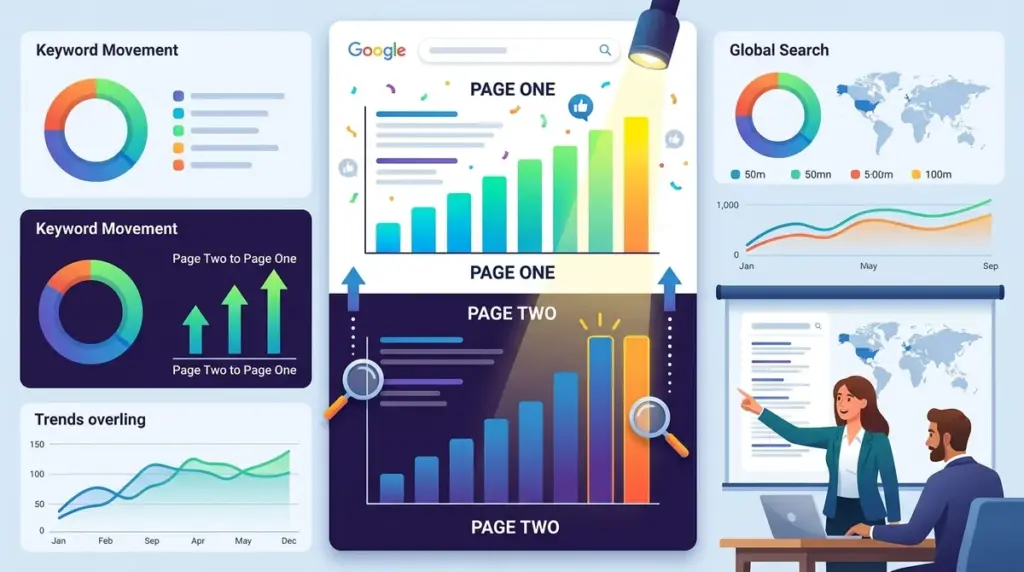
SEO budgets are finite, and the most expensive mistake a marketing manager can make is ignoring the "striking distance" keywords sitting on page two. While new content production often dominates the quarterly roadmap, the highest immediate ROI usually hides in positions 11 through 20. These are terms where Google has already indexed the page, understood the intent, and deemed the content relevant, but hasn't yet found the justification to grant it a top-ten spot. This is why you should pay attention to the keywords sitting in positions 11 to 30, as they offer quick wins.
Moving a keyword from position 12 to position 5 can result in a 500% increase in organic traffic, whereas moving a keyword from position 80 to position 20—while a larger jump in rank—yields virtually zero additional revenue. Page two is the threshold of commercial viability. To cross it, you need a surgical approach to optimization rather than a broad-brush content strategy.
The Mathematical Reality of the CTR Decay
The drop-off in Click-Through Rate (CTR) between the bottom of page one and the top of page two is a cliff. Most industry data suggests that position 10 receives roughly 2% to 3% of clicks, while position 11 drops below 1%. By the time a user reaches the middle of page two, the traffic is negligible. However, the effort required to move from position 11 to position 8 is significantly less than the effort required to rank for a brand-new, high-competition keyword from scratch.
Best for: Agencies looking to show "quick wins" to clients within the first 60 days of an engagement.
When a page sits on page two, the search engine is essentially telling you that your technical foundation is sound and your content is relevant, but you are lacking either specific topical authority or superior user experience signals compared to the current top ten. You are already in the race; you just need to finish the sprint.
Identifying High-Value Page Two Targets
Not every keyword on page two deserves a push. Success requires filtering your rank tracking data to find the intersections of high volume and high commercial intent. If a keyword has 5,000 monthly searches but the SERP is dominated by "People Also Ask" boxes, image carousels, and four paid ads, the organic "real estate" is too small to justify the resource spend.
Filtering by Commercial Intent
Prioritize keywords that signal a "buy" or "solve" phase. A page ranking #14 for "how to clean a coffee machine" is valuable, but a page ranking #12 for "best espresso machine for small offices" is a priority. Use your rank tracking tool to filter for these transactional modifiers. If the current ranking page is a blog post but the top three results are product category pages, you have an intent mismatch that no amount of backlinking will fix.
Analyzing the Competition’s Content Depth
Look at the "gap" between your page and the top three results. Often, page two rankings occur because the content is too thin or outdated. If your competitor at position 3 has a 2,000-word guide with original photography and a video summary, and your page at position 12 is a 800-word text-only post from 2021, the path forward is clear. You aren't being out-linked; you are being out-resourced.
Tactical Moves to Bridge the Gap
Once you have identified your targets, the focus shifts to specific, measurable adjustments. Do not rewrite the entire page immediately; start with the elements that influence relevance and authority signals.
- Internal Link Injection: Find your highest-authority pages (using a tool to check URL rating or Page Authority) and add contextual internal links to the page-two target using exact or partial-match anchor text.
- Entity Enrichment: Use a natural language processing (NLP) tool to identify missing related entities. If you are ranking for "cloud security" but haven't mentioned "data encryption" or "latency," Google may view your content as incomplete.
- Heading Optimization: Ensure your H2s and H3s answer the specific sub-questions appearing in the "People Also Ask" section for that keyword.
- Update the "Freshness" Signal: Sometimes, simply updating statistics, adding a new paragraph of current context, and changing the "last updated" date can trigger a re-crawl that pushes a page into the top ten.
Pro Tip: Before making any content changes, check the "Search Appearance" in your Search Console. If your page-two keyword has a high impression count but a CTR below 0.5%, your meta title and description are likely the primary bottleneck. Fix the "clickability" before you spend hours rewriting the body copy.
The Role of User Experience and Dwell Time
Google’s algorithms increasingly weigh "successful searches"—meaning the user clicked your result and didn't immediately bounce back to the SERP. If your page is on page two, it might be because your load speed or mobile layout is frustrating users. Check your Core Web Vitals for that specific URL. A slow-loading hero image or a layout shift (CLS) can be the "invisible ceiling" keeping you off page one.
Consider the "Time to Answer." If a user searches for a specific price or a "how-to" step, and they have to scroll through three paragraphs of "In today's fast-paced world" fluff to find it, they will leave. Move the most important information to the top of the page to satisfy the user intent immediately.
Scaling the Page Two Strategy
For large-scale publishers or e-commerce sites, managing page-two keywords manually is impossible. You must automate the discovery process. Set up alerts in your rank tracking software for any keyword that enters the 11-20 range. This allows your content team to act while the momentum is already in your favor.
Best for: Enterprise SEO teams managing thousands of URLs where manual auditing is inefficient.
By treating page two as a "waiting room" for your high-performance content, you shift from a reactive strategy to a proactive one. You are no longer guessing what might rank; you are refining what already is ranking. This data-driven approach reduces the volatility of your SEO traffic and ensures that your content production budget is spent on winners.
Actionable Workflow for Striking Distance Keywords
To turn these insights into a repeatable process, follow this monthly audit cycle. This ensures that no high-potential keyword lingers on page two longer than necessary.
First, export all keywords ranking in positions 11 through 15. These are your "Tier 1" targets. Second, cross-reference these with your conversion data to identify which terms historically drive the most revenue. Third, perform a "SERP Audit" to see if the top results have changed format (e.g., from articles to videos). Finally, assign one of three actions: "Content Refresh," "Internal Link Boost," or "Technical Fix."
Monitor these keywords daily. Because they are so close to the first page, even minor changes in the algorithm or a competitor's site can cause them to fluctuate. Being the first to react to these shifts is often the difference between a #11 ranking and a #3 ranking.
Frequently Asked Questions
How long does it take to move a keyword from page two to page one?
If the move is driven by internal linking or meta-tag optimization, you can see results in as little as two weeks. If the move requires significant content rewrites or building new external backlinks, it typically takes 45 to 90 days for the search engine to re-evaluate the page's authority relative to the existing top ten.
Should I prioritize page two keywords over creating new content?
Generally, yes. The "cost per lead" or "cost per click" of moving an existing page from position 12 to position 5 is almost always lower than the cost of researching, writing, and promoting a new piece of content that may take months to even reach page five.
Why did my keyword move to page two and then get stuck?
This is often a sign of "content decay" or "intent shift." Google may have initially ranked your page on page one, but if users consistently bounced back to the search results or if competitors released more comprehensive data, your page was demoted to the "striking distance" zone. It stays there because it is relevant enough to be indexed, but not high-quality enough to be recommended. This situation highlights the missed potential that occurs when you only track page one rankings and neglect page two.
Can technical SEO issues keep a page on page two?
Absolutely. If a page has a high "Time to First Byte" (TTFB) or fails mobile-friendly tests, Google may intentionally suppress it from the top positions to ensure a better experience for mobile users, regardless of how good the actual text content is.